
With school supplies now out in Walmarts and Targets everywhere, it must be getting close to back-to-school! I’m really looking forward to my 2nd year of teaching math to an amazing age group of children we call “pre-teens”. I’ve got a little flutter in my chest and I’m chomping at the bit to get back into my classroom to decorate and start planning for this new year! I have a laundry list of things I want to tweak from last year as well as some new ideas I’ve been toying with. One I’ll be keeping in mind as I choose new tools and methods to experiment with: Is what I’m doing to build 21st Century skills in these learners?
As a math teacher in the digital age, I believe it is crucially important that we are not just producing students who are able to memorize facts and formulas and call that a math education. It is our responsibility as educators to produce students who are ready to live successful lives in our current and future world. This means we need to be helping them develop 21st Century skills.
It is easy to feel overwhelmed when I think about all of the things I need to do for my students. I want the learning in my classroom to be student centered, I need to use enough digital tools, I need to help them develop communication skills, I need to, I need to, I need to….. So are these “21st Century skills” one more thing I’m going to have to find a way to squeeze in? I don’t think so. The International Society for Technology in Education (ISTE) has developed standards for education in the digital age. These standards call for students to take ownership for their own learning to build and construct knowledge, be creative and innovative problem solvers, and to communicate safely all while effectively using digital tools (ISTE Standards, n.d.). To me, this sounds like exactly what we all know we should be expecting from our students in the first place. This is what college and career ready looks like! Until our states and our content standards catch up with this, I believe that it as equally possible as it is vital that we individually analyze our current teaching methods and adapt so that we are meeting the needs of our young students. It’s not so much a matter of adding things as it is taking what we already do in our classrooms and challenge ourselves by asking if it’s meeting the needs of a 21st Century learner. If it isn’t, what can we do about it?
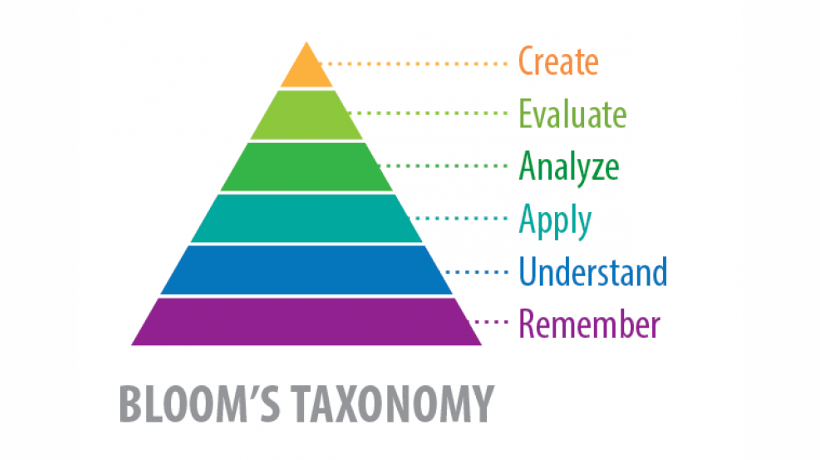
As I’ve been preparing for the new year and meeting with new math teachers I’ll get to work with this year, I’ve been considering what I can do differently this year to make sure that my students are moving beyond the basic depths of knowledge, or the first few rungs of Bloom’s Taxonomy. I usually run into the same brick wall when I start down this path: time. How do I ensure that my students have enough time and practice with basic understanding of skills and concepts so that we can move on to those application and creation tasks? I believe that students need to understand math from a conceptual level in order to move up the ladder of Bloom’s Taxonomy. The best ways I know to experience conceptual learning happen with hands-on, brains-on activities in the classroom. I also believe that mastery in math can only happen once students take that conceptual understanding and apply it to the higher-order thinking tasks. This is what is going to build the 21st Century skills they need.
Recently, I was challenged by an article I read about flipped learning. I was encouraged by the way that the authors described a flipped classroom as more than just video learning. It’s all about figuring out the best way to spend face-to-face time with our students (Sams & Bergmann, 2013). Do they need to hear us lecture? Or do they need time to dig into the meat of the concepts we want them to learn in an environment where they can be hands-on, asking questions, and receiving guidance and nudging live and in person. I’m confident that this could be the solution to my brick wall!If I record some of my direct instruction, I can then spend less time re-teaching and re-explaining and more time helping push my students to apply their knowledge. The authors also described how successful flipped learning structure can mesh extremely well with a problem-based learning design as well (Sams & Bergmann, 2013). This is also really exciting to me. Problem-based learning is also a vision I see for my classroom; I envision all the ways it can help my students become confident problem solvers. This fall, I am challenging myself to find at least one unit that I can “flip”. Stay tuned for updates as I give flipped learning a whirl!
ISTE Standards: https://www.iste.org/standards/for-students
Flipped Learning Article: http://www.ascd.org/publications/educational-leadership/mar13/vol70/num06/Flip-Your-Students’-Learning.aspx

